

Baby Hair Oil for Growth: A Gentle Guide for Parents
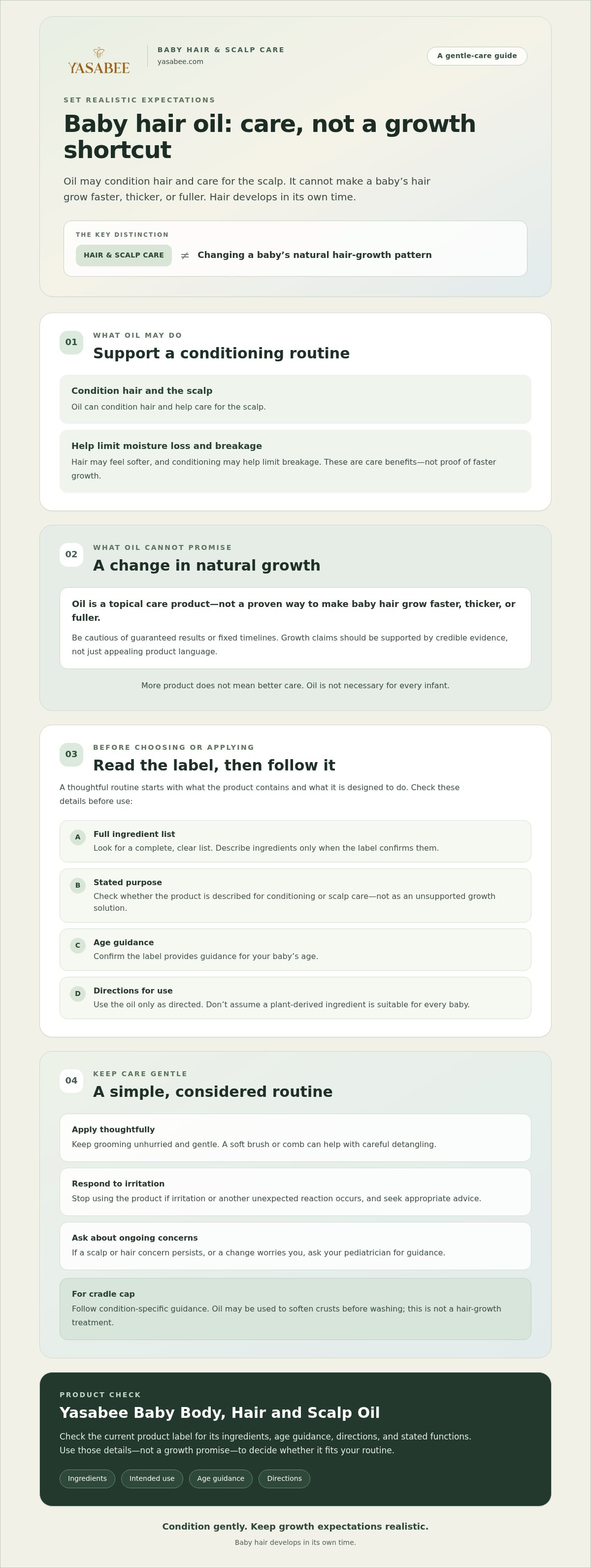
What if baby hair oil for growth isn’t really about making hair grow? It’s natural to hope oil might encourage fuller baby hair, while also wondering what’s gentle enough for delicate skin. Oil can condition hair and help care for the scalp, but it can’t make follicles grow hair faster or thicker. A baby’s hair develops in its own time.
This guide explains what oil can and can’t do, when gentle application may be useful, and how to compare a product’s ingredients, intended use, age guidance, and directions. If you’re considering Yasabee Baby Body, Hair and Scalp Oil, check its current label for those details rather than relying on a growth promise. A thoughtful routine starts with what a product is designed to do.
Key Takeaways
- Think of baby hair oil for growth as a conditioning step, not a way to make hair grow faster or thicker.
- Before use, check the label for age guidance and directions, then apply only as directed.
- If you notice irritation or an unexpected reaction, stop using the product and seek appropriate advice.
- Compare ingredients, stated purpose, and clear label information when choosing an oil, including Yasabee Baby Body, Hair and Scalp Oil.
Does Baby Hair Oil for Growth Actually Work? Set Realistic Expectations
Baby hair oil can condition the hair and help reduce moisture loss, but that’s different from stimulating new growth. A product may leave hair feeling softer and help limit breakage, yet there’s no basis here to promise that oil will make a baby’s hair grow faster, thicker, or fuller. Growth claims should be supported by credible evidence, not just appealing product language.
Scalp and hair needs vary from baby to baby. Oil isn’t necessary for every infant, and using more product doesn’t mean better care. The overview of specialty formulated baby products notes that subdued sebaceous gland activity in babies informs how products are formulated. Adult scalp-care assumptions may not apply to babies.
Can oil change a baby’s natural hair-growth pattern?
No. Hair oil is a topical care product, not a proven way to alter a baby’s natural growth pattern. Oil can condition the scalp and hair; it can’t make hair grow. If a product is marketed as a growth solution, look for credible evidence behind that specific claim. Be wary of guaranteed results or fixed timelines.
If you have an ongoing concern about your baby’s scalp or hair, or notice a change that worries you, ask your pediatrician for guidance rather than relying on oil to address it. The goal is suitable, gentle care, not trying to hurry a process that varies naturally.
How to Use Baby Hair Oil Thoughtfully and Choose It with Care
A gentle routine begins with the label, not a growth claim. Before using baby hair oil for growth, check the complete ingredient list, intended use, age guidance, and directions. Botanical ingredients can still affect individual babies differently, so ask a pediatric professional if you’re unsure whether a product is appropriate for your child.
What should parents check before applying an oil?
Check the full ingredient list, intended use, age guidance, and directions before applying any baby oil. Follow the label exactly, and don’t assume an ingredient is suitable simply because it’s plant-derived. Use the oil only as directed. Stop if irritation or another unexpected reaction occurs, and seek appropriate advice.
Keep grooming unhurried and gentle. A soft brush or comb can help with careful detangling. Yasabee’s gentle wooden baby brush and comb guide offers more grooming guidance. For cradle cap, Seattle Children’s Hospital discusses using oil to soften the crusts before washing. Follow its advice for that concern rather than treating oil as a general hair-growth remedy.
Yasabee offers Baby Body, Hair and Scalp Oil. Check its current product label for the ingredient list, age guidance, directions, and stated functions. To compare those details before deciding whether the oil fits your routine, explore Yasabee baby hair and scalp care.
Choosing a Baby Hair Oil for Growth Without Overpromising Results
A clear label is more useful than a promise of faster growth. When comparing baby hair oil for growth, look for a complete ingredient list, a specific intended use, age guidance, and directions you can follow. Claims about fuller or quicker-growing hair shouldn’t take the place of evidence or basic product information.
How to assess a product when ingredients and claims matter
Let the product’s current label guide your decision. Check what it contains and what it’s designed to do. Don’t fill in missing ingredient or use details from memory or assumptions. Botanical oils and moisturizing ingredients can only be described accurately when the label confirms them.
- Ingredients: Is the full list available and clear?
- Purpose: Does the label describe conditioning or scalp care, rather than making unsupported growth promises?
- Use: Are age guidance and directions provided?
Assess Yasabee Baby Body, Hair and Scalp Oil using its current label. Check its ingredients, age guidance, directions, and stated functions before deciding whether it suits your routine. For a distinct scalp concern such as cradle cap, dermatologists recommend condition-specific guidance. That guidance is not evidence that oil promotes hair growth.
Gentle care also includes how you handle the hair. Explore essential wooden grooming tools for infants for related grooming context. For product details, explore Yasabee baby care.
Choose a Gentle, Informed Care Routine
Keep expectations realistic: baby hair oil for growth may condition hair or care for the scalp, but it shouldn’t be treated as a proven way to make hair grow faster, thicker, or fuller. Ingredients, intended function, age guidance, and directions are more useful when choosing a product than a growth promise.
Use oil only as directed, and stop if you notice irritation or an unexpected reaction. If a scalp or hair concern persists, your pediatrician can help you decide what care is appropriate for your baby. Before choosing Yasabee Baby Body, Hair and Scalp Oil, check its current label for ingredients and intended use.
Explore Yasabee baby care and choose each step with care. Your gentle attention matters more than trying to hurry your baby’s natural development.
Frequently Asked Questions
Can baby hair oil make a baby’s hair grow faster?
No. Baby hair oil for growth can condition hair and help reduce moisture loss, but it isn’t proven to make hair grow faster, thicker, or fuller. Treat it as a scalp or hair-care product, not a growth treatment. Be cautious of promises about specific results, and ask your pediatrician about persistent concerns with your baby’s hair or scalp.
Is baby hair oil appropriate for a newborn?
It depends on the specific product and your newborn’s needs. Check the label for age guidance, intended use, ingredients, and directions before applying anything. Don’t assume an oil is suitable just because it’s marketed for babies or contains botanical ingredients. If the label doesn’t clearly address newborn use, or you’re unsure, ask your pediatrician first.
How often should I apply oil to my baby’s scalp?
There isn’t one application schedule that suits every baby or product. Follow the oil’s directions and use it only for its stated purpose. Don’t add applications in hopes of encouraging hair growth. If your baby’s scalp has a persistent concern, ask your pediatrician what care is appropriate rather than increasing how often you apply oil.
What should I look for in a baby hair oil?
Choose based on clear product information, not a promise of faster growth. Check the complete ingredient list, stated function, age guidance, and directions. Look for specific moisturizing ingredients or botanical oils only when they’re confirmed on the current label. For Yasabee Baby Body, Hair and Scalp Oil, verify those details on its label before deciding whether it suits your baby’s care routine.