

Baby Products Without Parabens and Phthalates: A Parent’s Buying Guide
What if the most reassuring words on a baby care label aren’t the most useful ones? Choosing baby products without parabens and phthalates can feel difficult when ingredient lists are unfamiliar and front-label claims leave questions unanswered. A closer look at the product’s ingredients and intended use can help you make a more informed choice for your family.
Start with the full ingredient list and a clear, product-specific claim, rather than relying on a single “free-from” phrase. This guide explains how to recognize relevant ingredient names, compare product details, and choose everyday essentials based on what they are designed to do. You’ll also find practical ways to assess shampoo and body wash, lotion, and body, hair and scalp oil without making assumptions about a formula.
Key Takeaways
- Understand what paraben and phthalate claims refer to, and why excluding a specific ingredient doesn’t describe an entire formula.
- Compare baby products without parabens and phthalates by checking ingredient lists, intended use, and how clearly claims are explained.
- Look beyond broad terms like “gentle” or “clean” for specific, readable information about a product’s ingredients.
- Match wash, lotion, and body, hair, and scalp oil to their stated functions and the needs of your everyday routine.
Baby Products Without Parabens and Phthalates: What Those Claims Mean
Ingredient-focused claims can help narrow your choices, but a front-of-package statement tells only part of the story. To compare baby products without parabens and phthalates, look at the product’s full ingredient list, its stated purpose, and whether the claim applies to that specific formula.
What should parents look for on a baby product label?
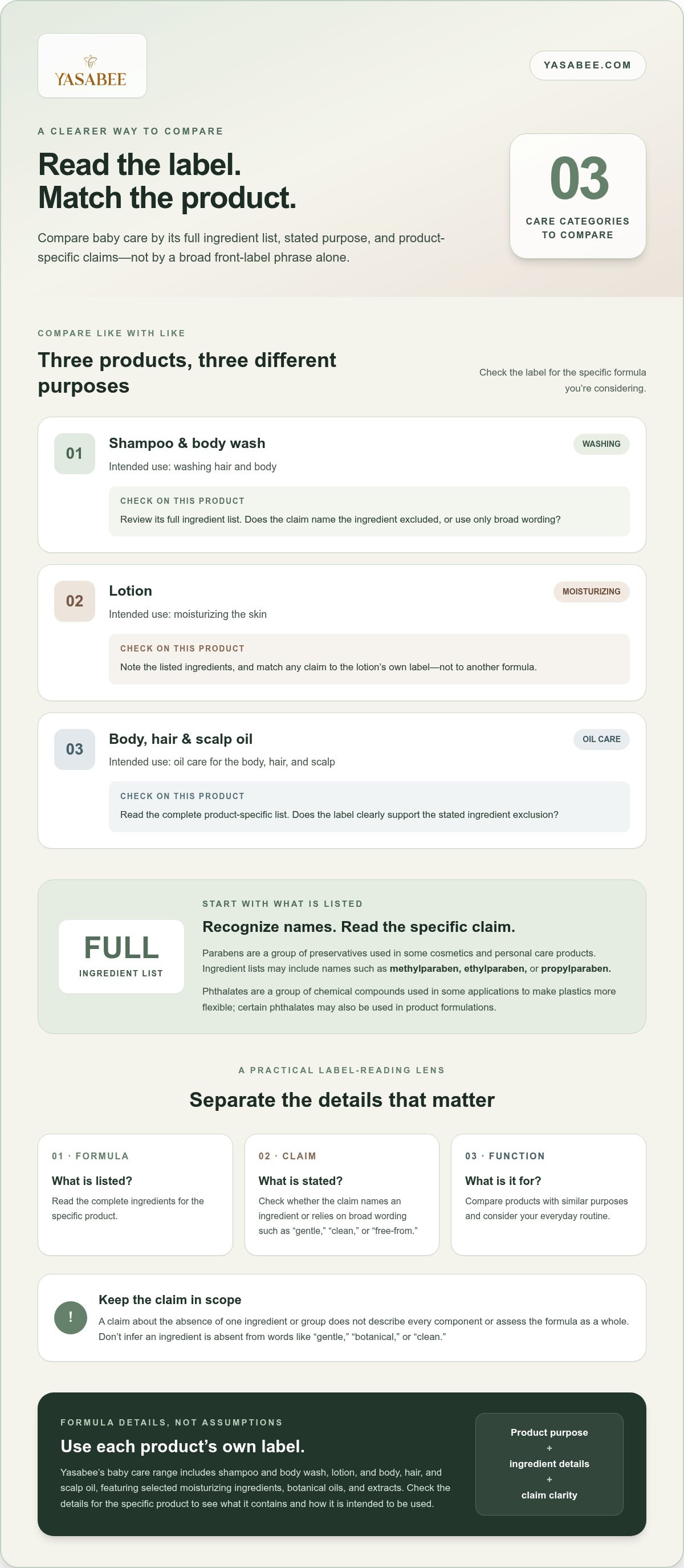
Parabens are a group of preservatives used in some cosmetics and personal care products to help limit the growth of microorganisms. Ingredient lists may include names such as methylparaben, ethylparaben, or propylparaben. What are parabens? offers a fuller overview. Phthalates are a group of chemical compounds used in some applications to make plastics more flexible, and certain phthalates may also be used in product formulations.
Read the complete ingredient list instead of relying on words such as “gentle,” “clean,” or “free-from” on the front label. If you want to avoid a particular ingredient, look for its name and read the product’s claim closely. A claim about the absence of one ingredient or group does not describe every component or assess the formula as a whole.
Compare products that serve the same purpose. Shampoo and body wash, lotion, and body, hair, and scalp oil have different uses, so check each product’s own label rather than applying one item’s claim to another. Yasabee’s baby care range includes these categories and features selected moisturizing ingredients, botanical oils, and extracts. Use the ingredient details for the specific product you’re considering to see what it contains and how it is intended to be used.
How to Compare Baby Products Without Parabens and Phthalates
A simple side-by-side comparison makes label reading more manageable. For baby products without parabens and phthalates, separate what the package clearly states from what you prefer in a formula. “Gentle” and “clean” are broad descriptions. On their own, they do not establish whether a specific ingredient is absent.
Which details make a baby care product easier to assess?
Compare products with similar purposes, then read each full ingredient list alongside its stated use. Note the exact product name and the claim you’re evaluating, so you don’t confuse one formula with another. The FDA’s information on parabens in cosmetics offers additional context for understanding these ingredients and cosmetic labels.
| Product category | Intended use | Listed ingredients | Clarity of claim |
|---|---|---|---|
| Shampoo and body wash | Washing hair and body | Review the full list on the specific product | Does it name the ingredient excluded, or use only broad wording? |
| Lotion | Moisturizing the skin | Note listed ingredients without assuming they apply to another formula | Can you match the claim to the product’s own label? |
| Body, hair and scalp oil | Oil care for the body, hair and scalp | Check the complete product-specific list | Does the label clearly support the stated exclusion? |
If a product label doesn’t establish that parabens or phthalates are absent, don’t infer their absence from words like “gentle,” “botanical,” or “clean.” Treat ingredient details as formula information, front-label wording as a claim to interpret, and your preferences as a separate part of the decision.
For a closer look at comparing lotion by its purpose and formula details, explore Yasabee’s baby moisturizing lotion guide.
Choose Baby Care by Formula, Function, and Everyday Routine
A considered routine doesn’t need to include every product category. Begin with the products your family uses, then compare each item’s stated purpose and ingredient list with your preferences. This keeps the search for baby products without parabens and phthalates focused on practical choices instead of broad promises.
How can families build a thoughtful baby care selection?
Match the product to its purpose: shampoo and body wash for washing, lotion for moisturizing, and body, hair, and scalp oil for oil care in those areas. Yasabee also offers a wooden brush and comb set and a silicone finger toothbrush. Choose the items that fit your routine, and use each product’s own label to review its ingredients. Yasabee’s baby care features selected moisturizing ingredients, botanical oils, and extracts; check the specific product details to identify its listed ingredients and intended function.
Ingredient preferences are one part of the decision. The product’s function and the clarity of its information can also help you decide whether it fits your household. For broader research context, readers can explore this scientific review discussing the health impacts of phthalates.
If you’re choosing a considered present, Yasabee’s premium baby gift set guide offers ideas to explore. For everyday care, browse Yasabee baby care and compare the product categories with your family’s needs.
Choose Baby Care with Clarity and Confidence
Choosing baby products without parabens and phthalates starts with clear, product-specific information. Read the full ingredient list, distinguish a named ingredient exclusion from broad terms like “gentle,” and consider what each product is designed to do. Shampoo and body wash, lotion, and body, hair, and scalp oil serve different roles, so let your family’s routine guide what you choose.
You don’t need to choose every category at once. Compare the available formula details with your preferences, and don’t assume an ingredient is absent unless the product information supports that claim. A focused comparison can make label reading feel more manageable.
Explore Yasabee baby care and thoughtfully curated gifts to find everyday care products or a gift for new parents.
Frequently Asked Questions
Are baby products without parabens and phthalates automatically safer?
No. An absence claim tells you something about selected ingredients, but it doesn’t assess the entire formula or determine whether a product suits your baby or your family’s preferences. Read the full ingredient information, consider the product’s intended use, and follow any guidance from your child’s healthcare professional if you have specific concerns.
How can I check whether a baby product contains parabens or phthalates?
Start with the product’s full ingredient list and look for specific ingredient names rather than relying only on front-label claims. Compare the list with the product’s own stated exclusion. If the label doesn’t establish whether an ingredient is present or absent, don’t assume either. Look for clear, product-specific information before drawing a conclusion.
Can “fragrance-free” guarantee that a baby product is phthalate-free?
No. “Fragrance-free” and “phthalate-free” describe different claims, so one doesn’t automatically establish the other. On U.S. labels, “fragrance” or “parfum” may refer to a blend without identifying each component individually. If avoiding phthalates is important to your family, look for a clear, product-specific statement and don’t treat “fragrance-free” alone as proof of absence.
What should I compare when choosing baby skincare products?
Compare products with the same purpose by reviewing their full ingredient lists, stated functions, and the clarity of any specific ingredient claims. For example, assess a shampoo and body wash alongside another wash product, and lotion alongside another lotion. Evaluate baby products without parabens and phthalates using their own formula details, not broad terms such as “gentle” or “clean.”