

Best Baby Products Without Synthetic Fragrance: A Thoughtful 2026 Guide
A baby wash that smells like nothing may still contain ingredients added to mask other odors. That’s why finding the best baby products without synthetic fragrance takes more than choosing a bottle labeled “unscented.” If you’re comparing options for your baby, knowing how to read the label can help you make a more considered choice.
This guide explains how “fragrance-free,” “unscented,” and naturally scented differ, then compares baby-care products by their intended role and disclosed ingredients. You’ll learn what to look for when comparing washes, lotions, and oils, and how to make a shortlist based on the routine your family actually uses. We’ll also look at familiar categories such as shampoo and body wash, lotion, and body, hair, and scalp oil, without assuming that products in the same category share the same ingredients or fragrance status.
Key Takeaways
- Learn how fragrance-free, unscented, and scented labels differ, and why the full ingredient declaration matters.
- Compare washes, lotions, and oils by their distinct care roles instead of treating them as interchangeable.
- Use product purpose, current ingredient lists, and disclosed fragrance information to shortlist the best baby products without synthetic fragrance for your routine.
- Explore Yasabee’s bath, moisturizing, oil, grooming, and gift-set categories, described by their product types and intended roles.
How to Identify Baby Products Without Synthetic Fragrance
Start with the ingredient declaration, not just the promise on the front of the bottle. “Synthetic fragrance” generally refers to scent ingredients made through synthesis, but fragrance blends can include materials from different sources. The source of an ingredient alone doesn’t establish its effect. For a general overview of what fragrance can encompass, consider how scent compositions may draw on both natural and synthetic ingredients.
The ingredient list, not front-label language alone, is the clearest guide to disclosed fragrance information. Labels can help narrow your choices, but read the full declaration on the current product rather than relying on a general claim.
What do fragrance-free and unscented mean on baby-care labels?
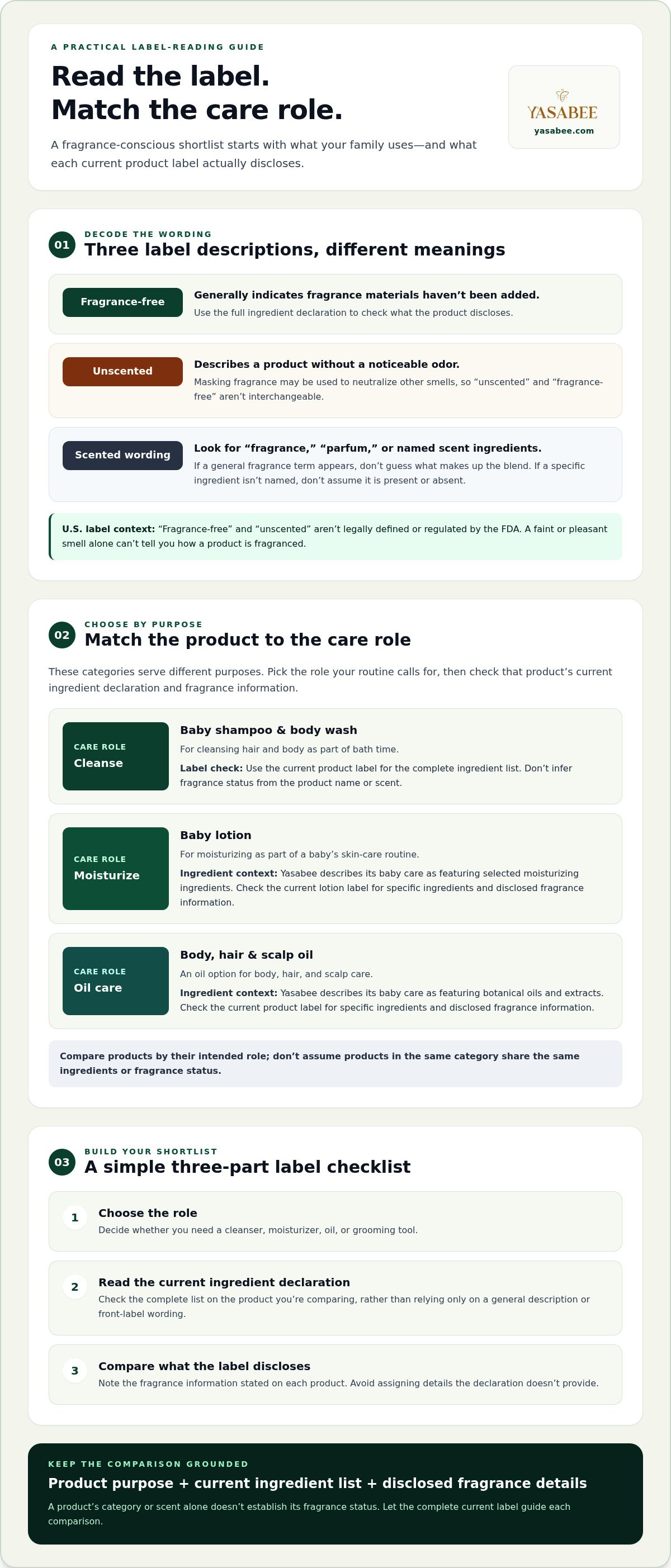
In the United States, “fragrance-free” and “unscented” aren’t legally defined or regulated by the FDA, so don’t assume the terms mean the same thing. “Fragrance-free” generally indicates that fragrance materials haven’t been added. “Unscented” describes a product without a noticeable odor; masking fragrance may be used to neutralize other smells.
A scented product may list “fragrance” or “parfum,” or disclose particular scent ingredients. Read the complete ingredient declaration and note what it names. If the label uses a general fragrance term, don’t guess which ingredients make up the blend. If it doesn’t name a particular ingredient, don’t assume that ingredient is present or absent.
To make a considered shortlist of the best baby products without synthetic fragrance, compare current labels product by product. “Fragrance-free,” “unscented,” and naturally scented aren’t interchangeable descriptions, and a faint or pleasant smell alone can’t tell you how a product is fragranced.
Compare Baby Washes, Lotions, and Oils by Ingredients and Purpose
A wash, lotion, and oil each have a different role in a baby-care routine. First decide what you need, then compare products in the same category and read the current ingredient declaration for specific contents and fragrance details. The FDA offers further context on how fragrances are regulated, including how fragrance ingredients may appear on cosmetic labels.
| Product type | Intended function | Disclosed ingredients | Label-based fragrance status |
|---|---|---|---|
| Baby shampoo and body wash | For cleansing hair and body as part of bath time. | Use the current product label for the complete ingredient list. | Check the declaration; don’t infer status from the product name or scent. |
| Baby lotion | For moisturizing as part of your baby’s skin-care routine. | Yasabee describes its baby care as featuring selected moisturizing ingredients; use the current lotion label for specific ingredients. | Assess the current label rather than assuming it is fragrance-free or unscented. |
| Baby body, hair and scalp oil | An oil option for body, hair, and scalp care. | Yasabee describes its baby care as featuring botanical oils and extracts; use the current product label for specific ingredients. | Use the current declaration to assess disclosed fragrance information. |
Which baby-care product category fits your routine?
Choose a cleanser for bath-time washing, a lotion for moisturizing, or an oil for body, hair, and scalp care. These products have different purposes, so choose according to the care roles your routine calls for rather than assuming you need every category. For more on lotion considerations, read the baby moisturizing lotion guide.
When comparing the best baby products without synthetic fragrance, assess each product by its intended role and current label, not by assumptions about its category. Explore Yasabee’s baby-care range as you build a shortlist around the products your family uses.
Build a Fragrance-Conscious Baby-Care Shortlist with Confidence
A useful shortlist starts with your routine, not a broad promise on a package. For each product, follow three steps:
- Choose the role. Decide whether you need a cleanser, moisturizer, oil, or grooming tool.
- Read the current ingredient declaration. Check the product’s full list rather than relying on a general description.
- Compare disclosed fragrance information. Record what the label states, and avoid assuming details the declaration doesn’t provide.
How can you compare a shortlist without relying on broad claims?
Keep each comparison tied to the product’s category, function, and current ingredient declaration. Clear ingredient and fragrance information helps you compare what product labels disclose instead of relying on broad claims alone. This approach lets you assess the best baby products without synthetic fragrance against your family’s needs without assigning an unverified fragrance status.
Yasabee’s range includes Baby Shampoo & Body Wash, Baby Lotion, Body, Hair and Scalp Oil, a Wooden Brush & Comb Set, a Silicone Finger Toothbrush, and the Luxury Baby Gift Collection. Yasabee baby care is thoughtfully formulated with selected moisturizing ingredients, botanical oils and extracts. For fragrance-conscious choices, refer to each product’s current ingredient declaration rather than assuming the same status across the range.
Explore Yasabee’s baby-care collection, or use the newborn skincare routine guide to consider how care categories can fit together. For gentle grooming, see the wooden baby brush and comb guide.
Choose a Routine That Feels Right for Your Family
A fragrance-conscious routine doesn’t require a crowded shelf. Start with the care roles your family actually uses, then compare each product’s current ingredient declaration and disclosed fragrance information. “Fragrance-free,” “unscented,” and scented labels can mean different things, so let the full label guide your shortlist of the best baby products without synthetic fragrance.
Yasabee’s range includes baby wash, lotion, body, hair and scalp oil, grooming tools, and a gift collection. Its baby care features selected moisturizing ingredients, botanical oils and extracts. Choose products by their intended role, and use current product labels for ingredient and fragrance details rather than assuming one claim applies across the range.
Explore Yasabee’s thoughtfully curated baby-care collection and choose the pieces that suit your baby’s routine. Careful label-reading can make each comparison clearer and more considered.
Frequently Asked Questions
Is fragrance-free the same as free from synthetic fragrance?
Not necessarily. Label wording and ingredient disclosure matter, so don’t assume “fragrance-free” and “unscented” mean the same thing or that either phrase fully explains a product’s scent ingredients. Read the complete, current ingredient list for disclosed fragrance information. A label alone can’t establish how every ingredient will affect every baby; individual responses can differ.
Can essential oils be considered synthetic fragrance?
Essential oils and synthetic fragrance are different ingredient categories, but an essential oil can still contribute scent to a product. Neither the ingredient category nor a “natural” description predicts how a particular baby will respond. Compare the complete ingredient declaration with your fragrance preferences; for individual skin concerns or reactions, seek advice from a qualified medical professional.
How do I choose baby products without synthetic fragrance?
Start by choosing the product role you need, such as wash, lotion, or oil. Then check its current ingredient declaration for disclosed fragrance information. Compare like with like, a wash against another wash and lotion against lotion. To shortlist the best baby products without synthetic fragrance, avoid treating broad marketing words as proof of a specific formulation.